The EU's Contradictory Story on Heat Pump Sovereignty
Europe can build all the heat pumps it needs. It does not build the compressors that go inside them. Germany will pay a bonus for 'made in Europe' anyway.
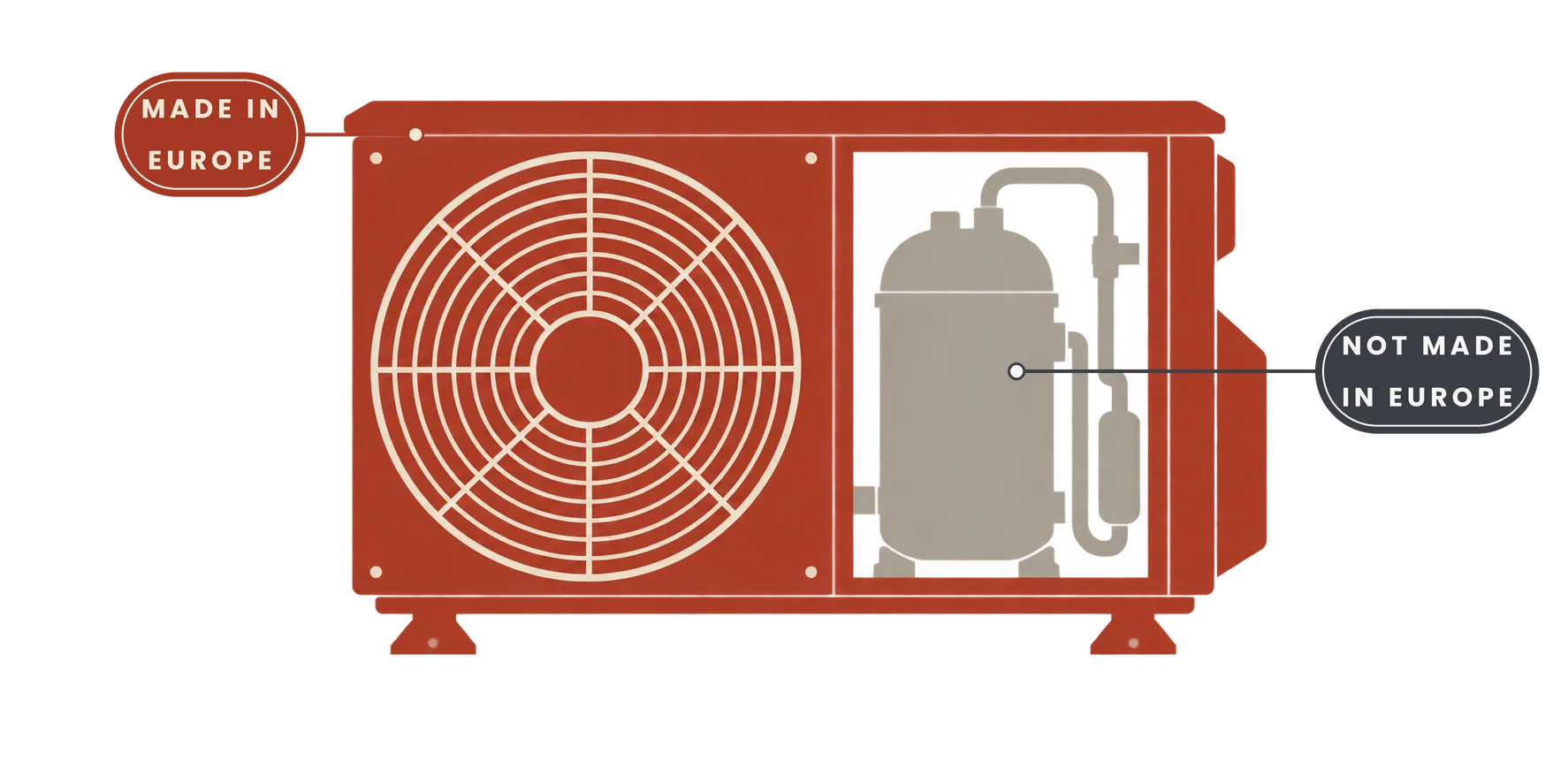

If you were to ask me: “Is the EU dependent on third countries for the supply of heat pumps for the residential market?” I would answer: “Yes”, purely based on my own experience and not think more about it.
However, recently the German Ministry for Economic Affairs and Energy (BMWE) announced that its subsidy scheme for residential heat pumps will incentivise heat pumps made in the European Union and associated markets. The changes mean the base subsidy will be cut from 30% to 15% while a new 15% Wertschöpfungsbonus will be introduced for heat pumps manufactured in Europe. This change is most likely in anticipation of the requirements that could follow from the Industrial Accelerator Act (IAA).
The BMWE’s press release tells us one of the main goals is to secure technical sovereignty.
Ziel ist es, Wertschöpfung, Beschäftigung und technologische Souveränität in Deutschland und Europa zu sichern und zu stärken.1
At the same time, when the European Commission provided information on the shares of the European Union supply of heat pumps and their main specific components as part of the Net-Zero Industry Act (NZIA), it claimed that only 22% are supplied by third countries.2
Therefore, the Commission concluded in its practical guidance on incentive schemes under NZIA:
The resilience of the heat pumps is assessed according to the calculation method provided in Section B.1 of this document. Since the 2025 Communication on the shares of Union supply does not identify a high dependency for either the heat pumps or their main specific components, all heat pumps get a pass mark for the resilience criterion.3
These seemingly contradictory statements challenged me to take a closer look. Is the EU dependent on third countries for its supply of residential heat pumps?
Claim 1: The EU is not dependent on others for its heat pump supply
Let us first look at any evidence supporting the conclusion in the practical guidance of the NZIA.
One of the most important sources here is the European Heat Pump Association (EHPA). It represents its members in the European heat pump sector. In April 2026, the EHPA published an article on the origin of heat pumps in the European market, in which it states:
The vast majority of air to water heat pumps installed in Europe are assembled in Europe, new data from the European Heat Pump Association representing over two-thirds of the market by number of units sold reveals. This compares to only around 10% which are assembled in China.4 — emphasis mine
This suggests there is plenty of manufacturing capability available in Europe. Director General Paul Kenny of the EHPA emphasises this by stating:
Want products ‘made in Europe’? The heat pump sector’s already delivering. But its 300 factories could produce over three times more heat pumps if the demand was there.4
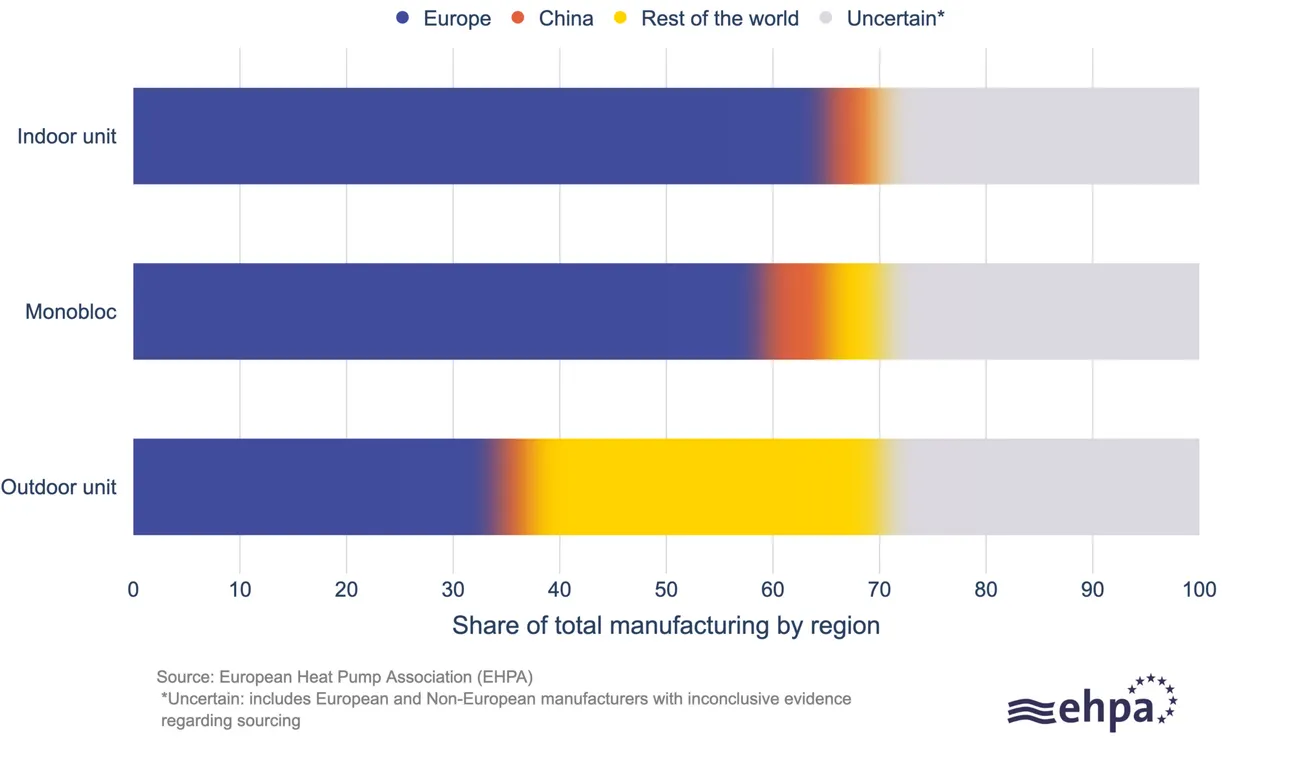
FIG 1 · Share of total manufacturing by region, by unit type. SOURCE: EHPA.
A similar story emerges when looking at the report of the International Energy Agency (IEA) called Advancing Clean Technology Manufacturing. It shows that, adding up current and announced capacity, almost 35% of global heat pump manufacturing capacity will be in the EU in 2030.5
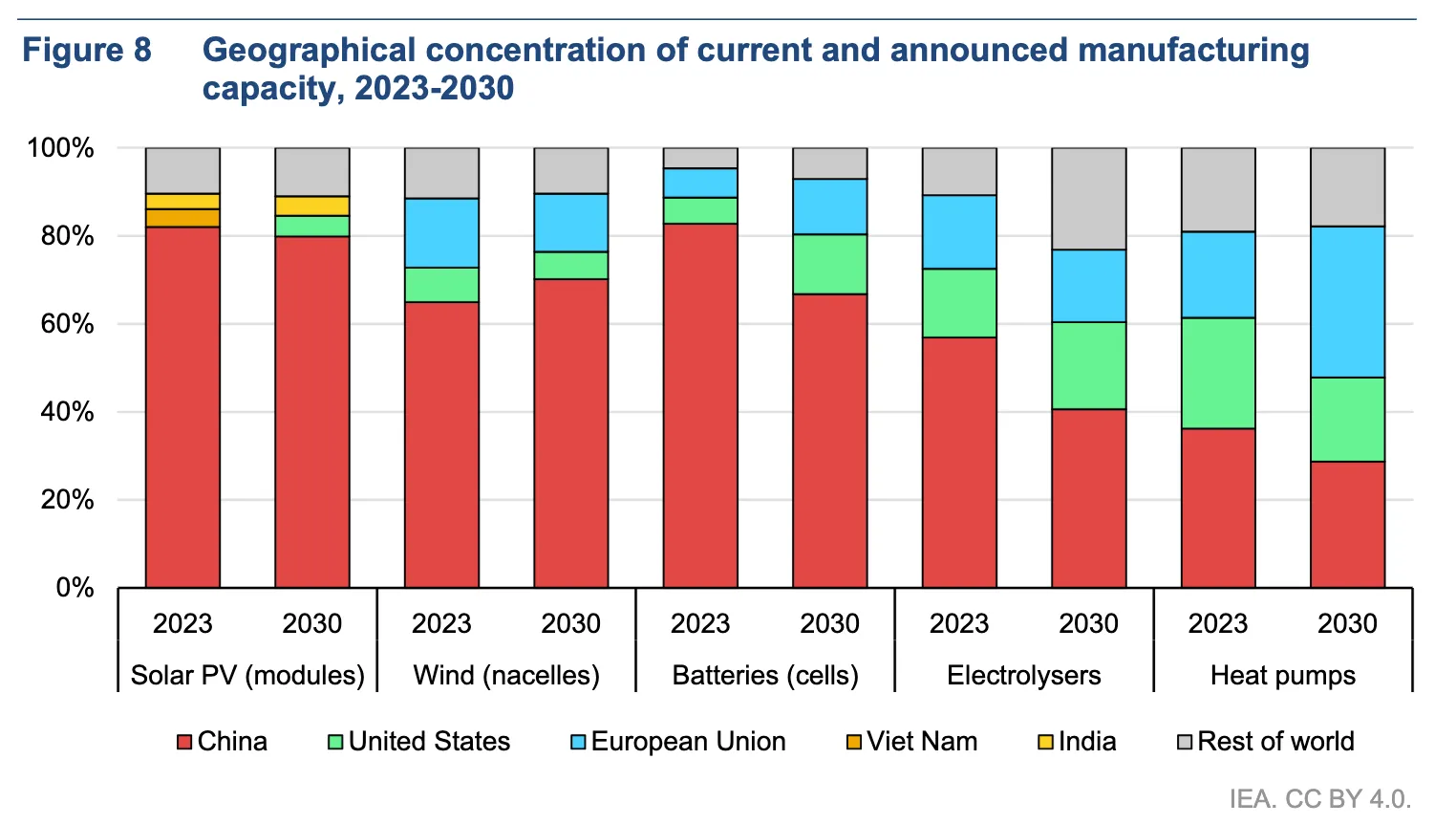
FIG 2 · Geographical concentration of current and announced manufacturing capacity, 2023–2030. SOURCE: IEA, Figure 8.
Finally, the report of the Joint Research Centre of the EU on heat pumps in the European Union contains even more evidence of an abundance of manufacturing capacity in the EU. The table shows that the current manufacturing capacity is already 117% of the 2030 deployment need:
| Production capacity in units | Current EU manufacturing capacity in GWth | EU deployment needs 2030 in GWth | 2030 EU manufacturing capacity benchmark |
|---|---|---|---|
| 7.7 million | 77 | 66 | 117% |
TABLE 1 · Assessment of EU manufacturing capacity for heat pumps.6
Looking in more detail at critical raw materials and components, the report concludes:
Heat pumps require limited critical raw materials and few components that cannot be manufactured in the EU. While heat pumps generally have few material-related vulnerabilities, the industry remains susceptible to broader trends, such as fluctuations in metal prices and disruptions in the supply of critical components like semiconductors and permanent magnets.6
Considering the reporting from EHPA, the IEA and the JRC, and the statements in the NZIA documents, the claim in the title of this section holds water. The technical sovereignty of the EU is not in danger and the EU is not dependent on third countries for its supply of heat pumps.
So where do these concerns come from?
Claim 2: The EU is dependent on others for its heat pump supply
In the same report of the JRC we just used to support the first claim there is support for the opposite claim on the same page. While it mentions the sufficiency of heat pump assembly capacity it also highlights the underlying problem: components.
Despite the limited data on other primarily used components (scroll compressors and four-way valves), it is evident that the EU lacks the capacity to meet the 2030 deployment requirements, or even 40% of those needs.6
Confusingly, the SWOT analysis presented in the JRC report also manages to contradict itself in a single table. It mentions under Strengths:
No imminent supply risks, a high degree of component commonality with other products.6
And under Weaknesses:
Import dependency of compressors, four-way valves (on refrigerant side), semiconductors and fluorinated refrigerants.6
Regardless of the contradiction it shows us a first glimpse at the reasoning behind the claim of dependency. Because the information on four-way valves is very sparse and on semiconductors very general, and because fluorinated refrigerants are already being phased out in the EU, we will focus on the most significant of the components mentioned: compressors. The JRC report states:
Compressor design and manufacturing is a specialised activity, so it has become dominated by a small number of global suppliers. Around 90% of compressors in European heat pumps are imported, according to industry experts.6
While this strongly supports the argument for dependency it also has a weakness. The claim is solely based on the statements of industry experts. It references only an unpublished JRC consultation, with no further underlying data.
Similarly, in the communication under NZIA that we used before, there is no explicit information on the source of compressors used in heat pumps assembled in the EU.2
The only related information I was able to find was a 2019 report by the US-based National Renewable Energy Laboratory (NREL) on the supply chain of compressors for room air conditioners.7 It concludes:
Company-specific compressor production capacity data show that nearly all rotary compressor production is concentrated in Asia, specifically China. The largest compressor manufacturing companies in China include GMCC, Gree, Highly, and Rechi. We find that these four companies, combined, account for over 60% of current global rotary compressor production capacity; GMCC alone accounts for about a quarter of global capacity.7
Additionally, it looks into the trade flows of compressors for air conditioners in 2017. While the information is not very recent, it provides insights into the origin of compressors.
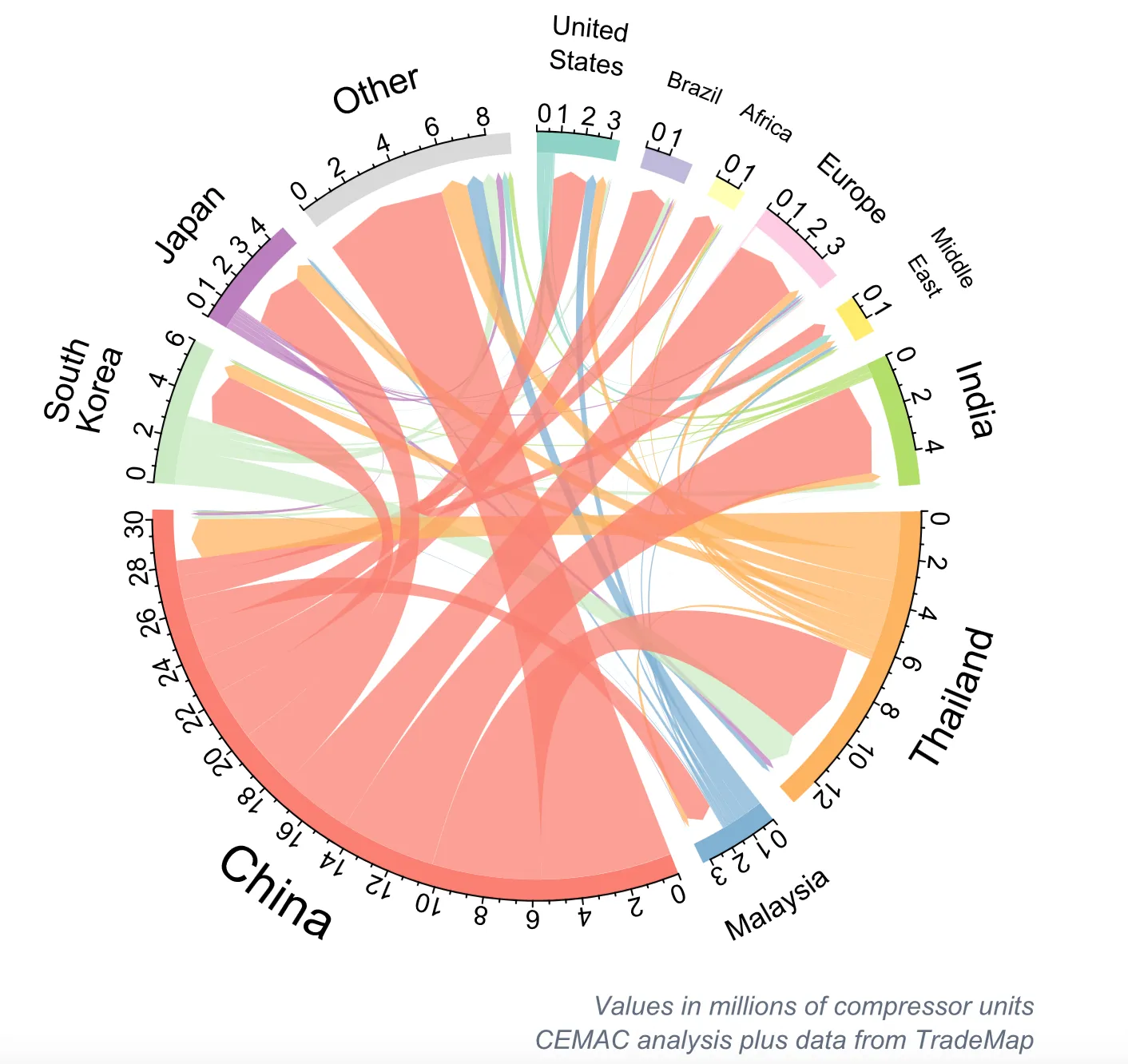
FIG 3 · Global compressor trade flow for air conditioners, 2017, in millions of units. SOURCE: NREL
Based on this it is reasonable to conclude that there is a dependency on other countries, specifically Asian countries, for the supply of compressors. While this aligns with my personal experience, the lack of information available from the EU is clear.
Despite all this uncertainty, the European Commission is very clear in its proposal for the IAA:
In other net zero technologies, such as heat pumps and geothermal, EU production depends heavily on components from non-EU suppliers.8
Conclusion
Both claims are partially true:
- The EU is not dependent on third countries for its heat pump manufacturing capacity.
- The EU is dependent on third countries for some components required for heat pump manufacturing.
This brings us back to the changes to the subsidy scheme in Germany. The changes mean an effective bonus to heat pumps made in Europe, and therefore a reduction in the number of heat pump installations that can apply for the full subsidy.
While the exact definition of ‘made in Europe’ has yet to be defined, it is unlikely to be based on the origin of the main components. Considering there is already sufficient manufacturing capacity for heat pumps in Europe and the main dependency is on the supply of main components, I don’t see how this change in the subsidy scheme will contribute to its stated goal of increasing technical sovereignty.
On the contrary, there is even a risk that pricing non-European competitors out of the market will reduce pressure on European manufacturers to compete on price and lead to increased prices for consumers. This is a risk also mentioned by the EHPA when commenting on the framework in the IAA in its position paper:
[I]t is essential that the framework remains carefully balanced, ensuring that measures aimed at strengthening EU manufacturing do not inadvertently slow down the deployment of heat pumps across Europe, unnecessarily disrupt global supply chains or affect affordability for end-users.9
So while supporting European heat pump companies seems like a positive thing to do, it has little to do with European dependency or technical sovereignty. If that were the case we would focus on building and supporting the production of core components within the EU.
Footnotes
-
BMWE — Sozialer, effizienter und fokussierter: die neue Gebäudeförderung, press paper (PDF), 8 July 2026. ↩
-
European Commission — Communication on the shares of Union supply of final products and their main specific components originating in third countries under the Net-Zero Industry Act, C/2025/3236, 2025. ↩ ↩2
-
European Commission — Guidance on Article 28 of Regulation (EU) 2024/1735 (Net-Zero Industry Act), C/2026/123, 2026. ↩
-
EHPA — Europe’s heat pumps are mainly ‘made in Europe’, 2026. ↩ ↩2
-
IEA — Advancing Clean Technology Manufacturing: An Energy Technology Perspectives Special Report, 2024. ↩
-
JRC — Clean Energy Technology Observatory: Heat Pumps in the European Union — 2025 Status Report on Technology Development, Trends, Value Chains and Markets, Publications Office of the European Union, 2025. Passages cited: pp. 7–8 (executive summary and SWOT, Table 1), p. 51 (compressors) and p. 52 (Table 6 and component capacity). ↩ ↩2 ↩3 ↩4 ↩5 ↩6
-
NREL — Mapping the Supply Chain for Room Air Conditioning Compressors, NREL/TP-6A20-73206, 2019. ↩ ↩2
-
European Commission — Proposal for a Regulation establishing a framework of measures for the acceleration of industrial capacity and decarbonisation in strategic sectors (Industrial Accelerator Act), COM(2026) 100 final, 2026. ↩
-
EHPA — Industrial Accelerator Act: EHPA’s position, 2026. ↩